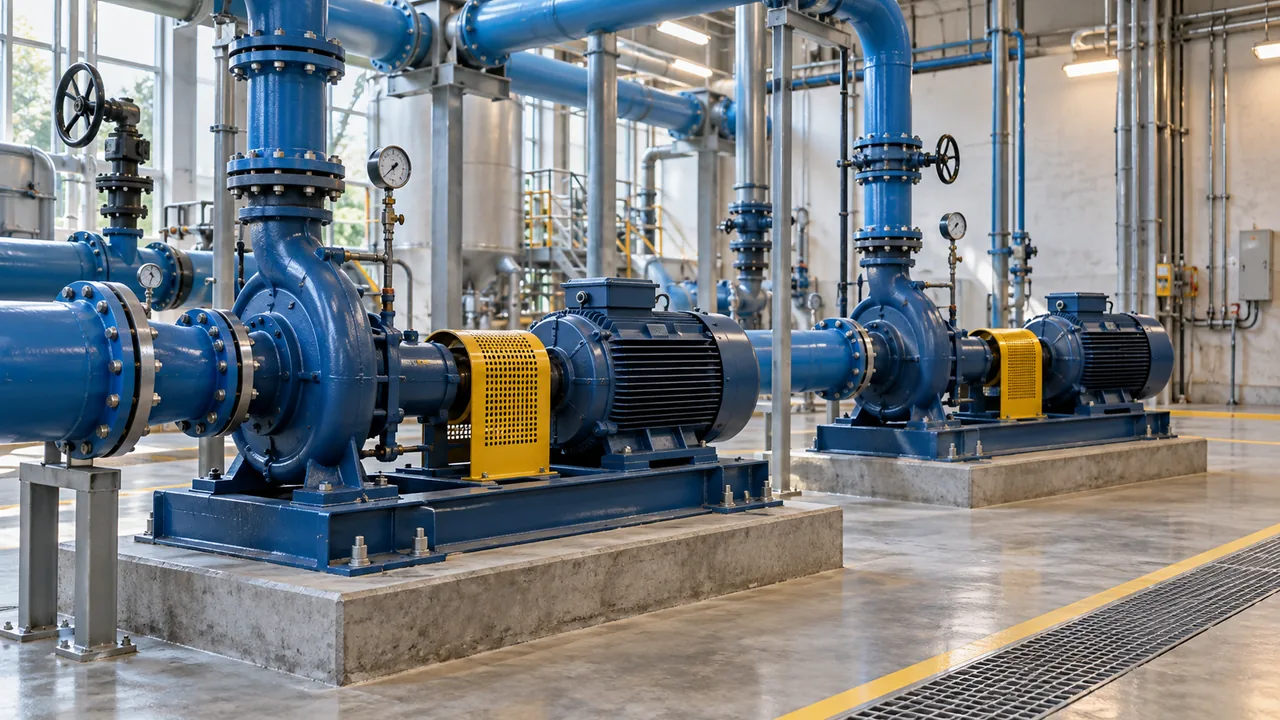
A factory water pump should not be selected by motor horsepower or pipe size alone. Water demand, source levels and operating schedules vary between plants. This guide helps production, maintenance and procurement teams agree on the information needed before comparing models, so the decision is based on the actual system rather than the largest available motor.
Define the application and required duty point first, then compare models, controls and long-term costs.
1. Identify the pump’s role in the factory
Separate tank-transfer, pressure-boosting, cooling-circulation and drainage duties. They move water, but the liquid conditions and operating patterns may differ significantly. A clean-water pump should not be assigned to water containing solids without checking the specific model’s limits.
For example, a supply system serving several wash stations needs information about simultaneous demand. A cooling loop needs information about the resistance of its equipment and piping. Defining the application gives suppliers a common basis for their proposals.
- List demand points and simultaneous operating periods.
- Distinguish clean water, hot water, wastewater and water containing solids.
- Specify continuous, intermittent or variable-load operation.
2. Establish flow and head before horsepower
Flow is the required delivery rate, commonly expressed in m³/h. Head represents the energy the pump adds per unit weight of liquid and is commonly expressed in metres. It is not simply building height: the designer must consider pressure requirements, elevation and system losses.
For an open tank-to-tank system, elevation differences may contribute to head. In a filled closed loop, building height should not automatically be added in the same way. Have the responsible designer assess the actual circuit, then ask the supplier to check the required flow–head pair against the pump performance curve.
Manufacturer reference: Grundfos — reading a pump curve ↗
Next: comparing industrial water pump types and specifications →
3. Capture the site conditions
Record the lowest and highest suction-side water levels, water temperature, existing pipework and maintenance access. These details reduce the risk of selection based on assumptions that do not match the plant.
For continuity-critical systems, discuss standby capacity, duty rotation and isolation for maintenance. The backup arrangement should reflect the consequence of an outage, rather than adding every possible accessory by default.
- Water quality, temperature and contamination.
- Source levels, pipe sizes and valve information.
- Available electrical supply and control-panel space.
- Operating hours, service criticality and permitted maintenance downtime.
4. Compare lifecycle cost, not just purchase price
A lower equipment price may exclude the base, pipework, valves, controls, installation or testing. Ask for itemised scope, warranty conditions and maintainable parts so quotations can be compared fairly.
Assess energy cost using actual operating conditions and hours. A larger motor is not automatically more economical, and a variable-speed drive does not guarantee savings in every system. Consider load variation, motor compatibility and the manufacturer’s permitted operating range.
Request the model’s performance curve and agree on acceptance checks, including recording flow, pressure and operating readings under stated site conditions.
5. Prepare a factory pump quotation checklist
Use the following list as a starting point. If flow or head is unknown, provide the system drawings and demand information for discussion instead of guessing values to complete a form.
- Application and water characteristics.
- Required flow–head or information needed to assess them.
- Pipe drawings, site photos and tank levels.
- Electrical supply, operating hours and space restrictions.
- Quantity, installation scope and delivery requirements.
Frequently asked questions
What horsepower does a factory water pump need?
There is no universal horsepower rating. Establish flow, head and liquid conditions first, then check the motor requirements of a model that can deliver that duty.
Can an existing pump be replaced like for like?
The old model is a useful starting point. Confirm whether demand, piping or operating conditions have changed, and identify the problem the replacement must solve.
Summary and next steps
A suitable factory water pump starts with system information, not an oversized purchase for reassurance. Share your site details and required scope with Treesing to discuss product selection and prepare a quotation.
Discuss your factory pump requirements ↗References and scope
Introductory guidance, not a substitute for system design or model-specific instructions. Confirm details with the manufacturer and responsible project personnel.