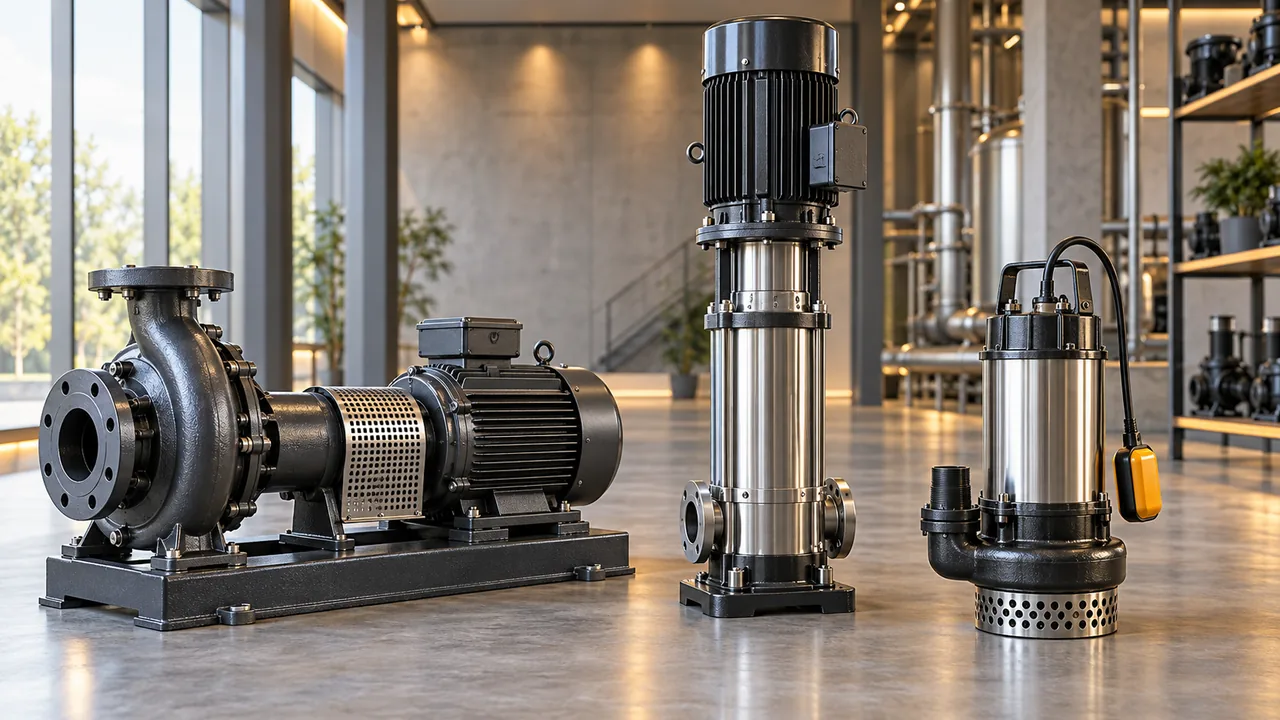
Industrial water pumps move water in production, building services and utilities. Applications range from clean-water transfer and pressure boosting to circulation and drainage. However, the word industrial does not make different pump types interchangeable. This guide introduces common water-pump categories and the specification checks needed before a purchase.
Match the type to the liquid, then assess the duty point, materials, suction conditions and model-specific limits together.
1. Common industrial water pump types
Use this table for initial screening, not as confirmation that every model in a category supports the same conditions.
| Type | Typical application to assess | Key checks |
|---|---|---|
| Centrifugal pump | General water transfer and circulation | Flow–head curve, materials and seal |
| Multistage pump | Boosting and higher-head duties | Working pressure, temperature and duty point |
| Submersible pump | Drainage, sumps and selected wastewater duties | Solids passage, water levels and motor conditions |
| Fire pump set | Fire protection with specific project requirements | System design, standards and actual set certification |
2. Treat flow and head as a pair
Maximum flow and maximum head in a catalogue generally occur at different points on the curve. They should not be combined into a duty the pump can deliver simultaneously. Specify the required pair and check it against the manufacturer’s recommended operating range.
Illustrative example only: a system requiring 30 m³/h at 40 m head cannot be approved simply because a catalogue lists 50 m³/h maximum flow and 60 m maximum head. Check the actual model curve, proposed impeller size and speed. These numbers are not a recommended specification for every project.
3. Match materials and seals to the actual water
Provide temperature, water quality, known dissolved substances and contamination so the supplier can assess wetted-part compatibility. The label stainless steel is not enough: material grades, seals and other components have different limits.
For production water with hygiene or certification requirements, state the requirements in the quotation request and verify the actual model documentation. Chemicals and hazardous liquids require specialist assessment rather than a general water-pump selection guide.
4. Assess suction conditions and NPSH
NPSH is important when assessing cavitation risk. It depends on suction pressure conditions and liquid properties. Available system NPSH and required pump NPSH are different quantities and must be compared at actual operating conditions with a suitable margin.
Have the designer assess water levels, temperature and suction losses against manufacturer data. Do not prescribe one margin for every pump type. Investigate unusual noise or vibration before continuing operation; sound alone does not confirm cavitation.
5. Request documents before purchase approval
Ask for the proposed model’s data, not only a brand brochure. Government and large-project purchases should check completeness against their own tender and acceptance criteria. Do not assume every product has the same standard or certification.
- Model- and speed-specific datasheet and performance curve.
- Materials, seal, motor and electrical details.
- Dimensions, weight and installation drawings.
- Installation and maintenance manuals, plus warranty terms.
- Required certification with its scope checked.
Frequently asked questions
How does a multistage pump differ from a centrifugal pump?
A multistage pump uses several stages to build head. What is commonly called a centrifugal pump may be a single-stage configuration. Selection still depends on the model curve and limits, not the category name alone.
Should a pump be oversized for future expansion?
Define current demand and a realistic expansion plan, then have the designer assess the operating range. Unchecked oversizing can leave a pump poorly matched to today’s load.
Summary and next steps
A suitable industrial water pump needs both category screening and specification checks. Share the flow–head requirement, liquid conditions and project criteria with Treesing to discuss products and supporting documents.
Discuss industrial pump selection ↗References and scope
Introductory guidance, not a substitute for system design or model-specific instructions. Confirm details with the manufacturer and responsible project personnel.